
Continuing the downward trend, retail inflation fell to a five-month low of 4.31 per cent in January, mainly due to a decline in the prices of vegetables, eggs, and pulses. The Consumer Price Index-based retail inflation was 5.22 per cent in December and 5.1 per cent in January 2024. The previous low inflation was in August 2024 at 3.65 per cent.

Latest GDP growth numbers a one-off development and not the beginning of a trend, says CEA V Anantha Nageswaran.

S&P Global Ratings on Wednesday said the impact of the US reciprocal tariff will be limited on India as the economy is domestically oriented with less reliance on exports. YeeFarn Phua, Director, Sovereigns and International Public Finance Ratings, Asia-Pacific S&P Global also said India will clock a 6.7-6.8 per cent GDP growth over the next two years.

IT services firm Wipro's revenue is likely to increase by about 4.5 per cent in FY26, mainly driven by favourable sectoral trends and recovery in discretionary customer spending, according to global rating agency Fitch.

Domestic rating agency Icra on Wednesday said India's real GDP growth for the September quarter is likely to decline to 6.5 per cent due to heavy rains and weaker corporate performance. The agency, however, maintained its FY25 growth estimate at 7 per cent on expectations of a pick up in economic activity in the second half of the fiscal.
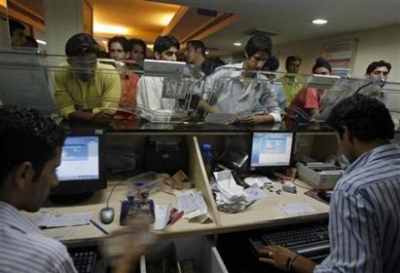
The spike at private sector lenders like ICICI Bank and Axis Bank follows a push to grab market share from India's dominant state banks.

The Reserve Bank of India's (RBI's) State of the Economy report for October acknowledged a slowdown in some high-frequency indicators but expressed confidence in a recovery, aided by consumption demand during the festival season. "In India, aggregate demand is poised to shrug off the temporary slowdown in momentum in the second quarter of 2024-25 as festival demand picks up pace and consumer confidence improves," said the report released on Monday.

Sugar prices are hovering near six-year highs, leaving a bad taste in Indian consumers' palates but sweetening the portfolios of investors in related stocks at Dalal Street. Shares of sugar manufacturers such as Piccadily Agro, DCM Shriram, Magadh Sugar, and Bajaj Hindustan have rallied up to a whopping 200 per cent so far in the financial year 2024 (FY24) as deficient monsoon rains in major sugarcane producer states like Maharashtra and Karnataka are expected to lead to a shortfall in sugar output ahead. In comparison, the BSE Sensex has modestly gained 11 per cent during this period.

India and the US are expected to have smooth trade negotiations after US President Donald Trump and Indian Prime Minister Narendra Modi had a productive meeting during Modi's visit to the White House last month, Stephen A Schwarzman, chairman, chief executive officer, and co-founder of one of the world's largest alternative investment firms, Blackstone Group, said in Mumbai on Wednesday.

India's services sector activity witnessed a sharp upturn in August on the back of stronger gains in new business, ongoing improvements in demand conditions and job creation, a monthly survey said on Monday. The seasonally adjusted S&P Global India Services PMI Business Activity Index rose from July's four-month low of 55.5 to 57.2 in August, amid a quicker upturn in business activity and the sharpest rise in employment for over 14 years. For the thirteenth straight month, the services sector witnessed an expansion in output.

'Consider 40% to 50% in equities, 10% in gold as a hedge, and the remaining 30% to 40% split between multi-asset funds and hybrid funds.'

'We never waste a crisis. There will be learning and the supervisory tools will get better with each episode.'

Although UltraTech Cement's results for the December quarter of the current financial year (Q3FY25) were not an improvement compared to Q3FY24, the company managed to surpass Street expectations. The company's profit attributable to the owners of the parent dropped 17.4 per cent year-on-year (Y-o-Y) to Rs 1,469.5 crore in Q3FY25 as against Rs 1,777 crore in Q3FY24.

The Nifty IT index, data shows, has outperformed the markets in each of the last four election years post the result. announcement.

Info Edge (India) reported good Q2FY24 results with hiring across other segments helping offset weak IT performance. The revenue increased 11.5 per cent year-on-year (Y-o-Y) to Rs 593 crore, (up 1.5 per cent quarter-on-quarter or Q-o-Q). The earnings before interest, taxes, depreciation, and amortization (Ebitda) margin was excellent at 40.7 per cent, up 200 basis points year-on-year (Y-o-Y).

Donald Trump's Presidency of the United States will open new opportunities for India though certain sectors, especially pharma and IT, may face the heat if the incoming president decides to impose restrictions on imports and H1B visa regulations, experts said on Wednesday. Prime Minister Narendra Modi's friendly relationship with Trump will have a positive bearing on Indo-US relations but India may have to adapt its strategies to maintain cooperation in areas of mutual interest.

'Challenge is basically near-term growth as the outlook has turned a bit adverse.'

Moody's, which cut its FY14 growth estimate to 4.5 per cent recently, said economic growth will be lowest in a decade.

Reserve Bank Governor Shaktikanta Das on Thursday said the fundamental drivers of the Indian economy are gaining momentum and the country is moving on a sustainable growth path. In the inaugural address at FIBAC 2024, the governor said that massive changes are taking shape in various economic sectors and markets, and the country is geared for orbital shifts.

Acceleration in demand, together with marginal price hikes of about 2-3 per cent by cement companies in the October-December quarter (third quarter, or Q3) of 2022-23, may not be enough to cushion the impact of high input costs on the bottom line, reveal Bloomberg consensus estimates for the quarter. Year-on-year (YoY) net sales growth in Q3 will come in at nearly 7 per cent, shows Bloomberg data, while bottom-line growth will show a sharp decline of 25 per cent from a year ago. The earnings before interest, tax, depreciation, and amortisation (Ebitda) will likely decline by nearly 5 per cent versus a year ago, shows data.

The 2022-23 (FY23) January-March quarter performance of the country's largest listed paint companies was better than Street expectations. Asian Paints, Berger Paints, and Kansai Nerolac Paints (Kansai Nerolac) registered double-digit revenue growth, compared with the year-ago quarter, reinforced by strong volume/value growth. Falling raw material prices also helped the paint majors hoist their gross margins.

India slips to second place on hiring outlook

'Despite the current uncertainties, the long-term outlook remains constructive due to strong fundamentals, government initiatives, and a stable banking sector.'
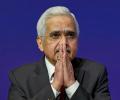
Outgoing Reserve Bank Governor Shaktikanta Das said on Tuesday that restoring inflation-growth balance is the most important task ahead of the central bank. Addressing a press conference on his last day as the central bank chief, Das said his successor will have to navigate the changing world order, effectively deal with cyber threats, and focus on harnessing new technologies.

India's manufacturing sector activity witnessed a significant loss of growth momentum in May due to the intensification of the COVID-19 crisis and its detrimental impact on demand, a monthly survey said on Tuesday. The seasonally adjusted IHS Markit India Manufacturing Purchasing Managers' Index (PMI), fell to 50.8 in May, down from 55.5 in April, as companies observed the slowest rises in new work and output in ten months amid intensification of the COVID-19 crisis. In PMI parlance, a print above 50 means expansion while a score below 50 denotes contraction.

The festive season will mean business for the steel industry as it is the time when automotive and consumer appliance companies bump up demand to prepare for higher sales, experts have said. Ranjan Dhar, chief marketing officer at ArcelorMittal Nippon Steel India (AM/NS India), said that bookings by auto and consumer appliance industries are 20 per cent higher ahead of the festive season compared to last year. "While this could be for a couple of months, it could normalise later at approximately 10 per cent," he said.

Accenture's Q1 FY22 results have sent a wave of cheer among analysts, as the company raised its revenue guidance and said it expects double-digit growth in outsourcing, up from single digit to low double-digit growth expected earlier. Accenture's financial year ends on August 31. The company raised its revenue outlook for FY22 to 19-22 per cent in local currency, up from 12-15 per cent earlier.

Automobile giant Tata Motors' shares were in demand on Wednesday as the stock rallied as much as 3.69 per cent to hit an intraday high of Rs 671.80 per share, before settling 3.18 per cent higher at Rs 668.45. By comparison, the BSE Sensex settled 0.10 per cent, or 72.56 points, lower at 74,029.76.

'Our AI strategy -- AI in Everything, Everything for AI, and AI for Everyone -- is now in action.'

InterGlobe Aviation, the operator of India's leading airline IndiGo, delivered a better than expected performance across most parameters in Q2FY24. The company posted its fourth consecutive quarter of net profit of Rs 188 crore. It had reported a loss of Rs 1,583 crore in the same quarter a year ago.

Trading sentiment in the equity market this week will be guided by global trends, foreign fund movement, macroeconomic data announcements and RBI's interest rate decision, analysts said. The monthly auto sales data announcement would also be tracked by investors this week.

Delhivery share price dropped 6.6 per cent to a low of ?295.8 per share on the BSE on Monday after analysts cut their earnings estimate on the stock, following weak results for the December quarter (Q3) of the current financial year (FY25). Q3 is a seasonally strong quarter due to festive pick-up in demand.

RBI interest rate decision, macroeconomic data and global trends would guide markets' movement this week, analysts said. Besides, trading activity of foreign investors and the last batch of Q1 earnings announcements would also guide trends in equities. HSBC PMI (Purchasing Managers' Index) for the services sector is scheduled to be announced on Monday.

Stocks of electronics manufacturing services companies have been major outperformers, with four of the top eight listed majors by market capitalisation doubling their value over the past 12 months. The biggest gainer in this space has been the market leader, Dixon Technologies (India), which is up nearly threefold.

The Survey is authored by Chief Economic Advisor V Anantha Nageswaran and his team.

Global factors and FII activity will dictate trends in domestic equity markets this week while assembly poll results of Maharashtra and Jharkhand may impact stocks on Monday, say analysts. Stock markets witnessed a spirited recovery on Friday with benchmark Sensex and Nifty notching the best single-day gains in more than five months and offering relief after weeks of correction.

The recent sell-off in IT stocks such as Infosys and Tata Consultancy Services (TCS) has resulted in a sharp decline in the IT sector weighting in the Nifty50 index. The sector's weighting in the index has slipped to a five-year low of 12.2 per cent, down from the 17.7 per cent at the end of March 2022. The top IT companies - TCS, Infosys, Wipro, HCL Technologies, and Tech Mahindra - accounted for 13.6 per cent of the index at the end of March this year.

India is among the three least-favoured Asian stock markets, according to BofA Securities whose survey found that 10 per cent of fund managers are underweight on Indian equities from a 12-month perspective.

Markets to track inflation data, global trends, FII trading this week: Analysts New Delhi, Dec 8 (PTI) Investors' sentiments will be guided by a host of domestic and global macroeconomic data announcements this week, along with the trading activity of foreign investors and trends in world stocks, analysts said. Besides, the rupee-dollar trend and movement of global oil benchmark Brent crude will also be crucial in dictating terms in the market, experts added. "The domestic stock market is likely to be shaped by a mix of global cues, domestic economic indicators, and the flow of investments from foreign and domestic institutional investors. Key factors like the rupee's exchange rate and crude oil prices will play a critical role in determining market trends. "Globally, geopolitical tensions, particularly the ongoing Russia-Ukraine conflict, continue to pose challenges. However, recent declines in the dollar index and US bond yields have created a more favourable environment for emerging markets like India," Pravesh Gour, Senior Technical Analyst, Swastika Investmart Ltd, said. On the economic front, significant macroeconomic releases, including retail inflation and industrial production data from India as well as US core CPI, are expected to influence overall market sentiment, Gour added. Last week, the BSE benchmark jumped 1,906.33 points or 2.38 per cent, and the NSE Nifty climbed 546.7 points or 2.26 per cent. "FIIs turning buyers in early December, in a total reversal of their sustained selling strategy during the last two months, has altered the market sentiments. The change in FII (Foreign Institutional Investors) strategy is getting reflected in stock price movements, particularly in large-cap banking stocks in which FIIs have been sellers," VK Vijayakumar, Chief Investment Strategist, Geojit Financial Services, said. The release of US CPI inflation data will give some insights into the Fed's December meeting, an expert said. "The markets' attention is expected to turn towards macroeconomic indicators like IIP and CPI inflation. Additionally, the trend of FII inflows, following their recent buying spree, will remain a key focal point for market participants," Ajit Mishra - SVP, Research, Religare Broking Ltd, said. Siddhartha Khemka, Head - Research, Wealth Management, Motilal Oswal Financial Services Ltd, said this week will see significant economic data releases, including GDP numbers from Japan and the UK, along with China's CPI and India's CPI.

The meltdown in Dalal Street that wiped out investor wealth to the tune of 44 trillion in 2025 also seems to be having a ripple effect on the country's vibrant automobile retail sales.
